

When you ask an AI a question, it doesn’t reason toward an answer. It generates the most statistically likely response based on patterns it memorized during training. This distinction matters more than the marketing around “thinking machines” suggests.
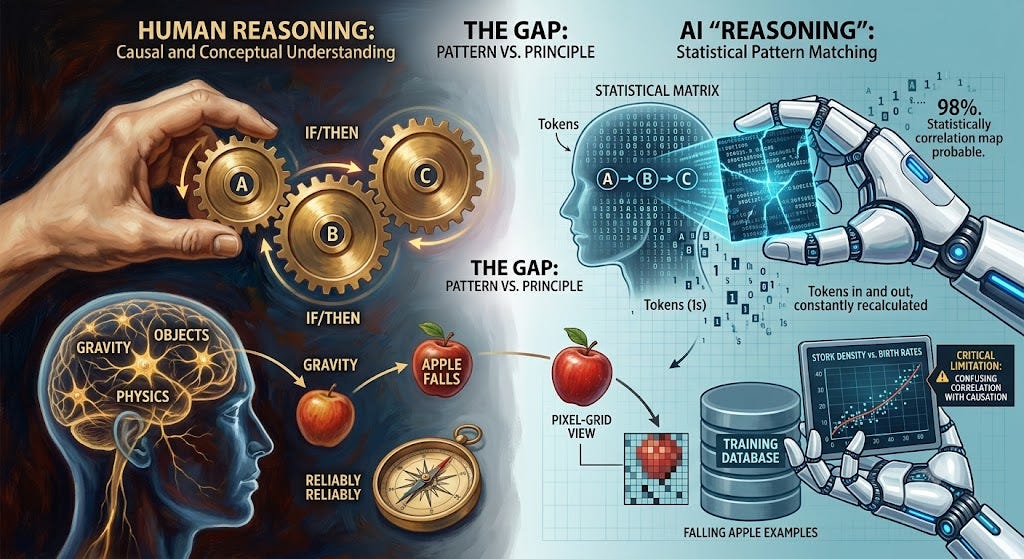
AI reasoning limitations are absolute. Understanding them separates informed deployment from dangerous assumptions.
What AI Actually Does: Statistical Pattern Matching
Large language models (LLMs)—systems like ChatGPT that process and generate text—don’t think. They perform statistical pattern matching at extraordinary scale. Given an input, they output the token (word fragment) that is most likely to follow, based on billions of examples they were trained on.
That’s it. That’s the whole mechanism.
Ask an LLM “What is 2+2?” and it doesn’t compute. It outputs “4” because in its training data, “4” statistically follows that question more often than “5” does. The model learned a pattern. It didn’t learn mathematics.
This works because addition appears so consistently in training data that the pattern-matching approach produces correct answers. But push the model into novel territory—territory where the statistical pattern is different or missing—and the illusion breaks.
Correlation vs. Causation: The Model’s Fatal Blind Spot
Here’s a classic example: storks and human birth rates are correlated. Countries with more storks have higher birth rates. A statistical model trained on this data would “believe” that storks cause births.
Obviously, they don’t. Humans understand causation—the mechanism by which one thing causes another. We know that more storks don’t produce more babies. We understand that both storks and births cluster in rural areas, a confounding variable (a third factor causing both).
AI models learn correlation, not causation. They find statistical patterns, not mechanisms. This works fine until the correlation breaks. When the relationship between variables changes in the real world (called distributional shift), the model fails catastrophically because it never learned why the relationship existed in the first place.
A medical AI trained on data where a certain symptom correlates with a disease might work in the hospital where it was trained. Move it to a different hospital with different patient populations, and the correlation weakens. The model has no causal understanding to fall back on. It fails silently.
