

You’ve got an AI task. ChatGPT does most of what you need, but not exactly. So what’s the move: tweak your prompts or retrain the model? The answer depends on your constraints, your task, and your budget. Let’s untangle fine-tuning vs. prompt engineering.
What’s the Difference?
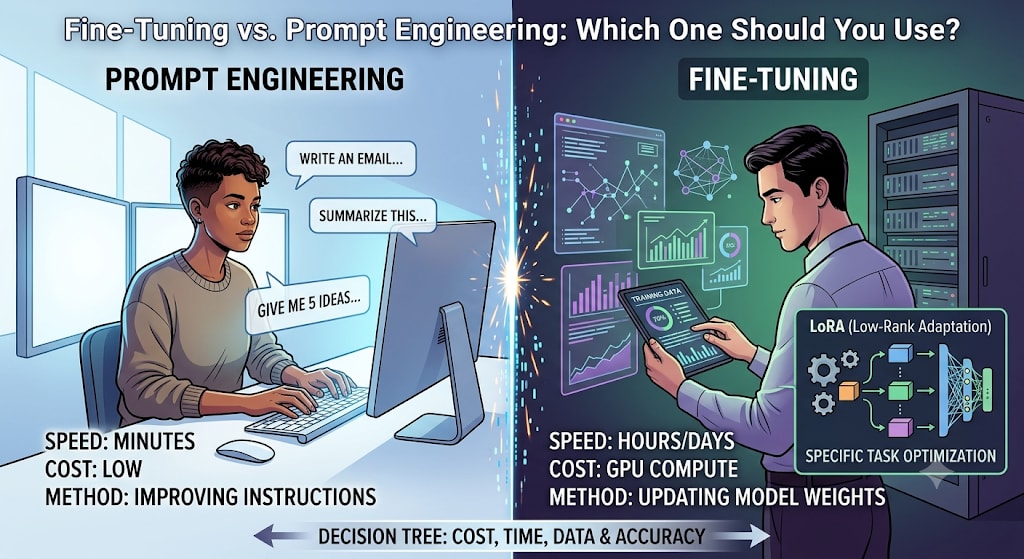
Prompt engineering is what you’re probably already doing: writing better instructions to get better answers. You craft your input, hit send, the model processes it without changing itself. The model’s weights—the numerical parameters that define how it works—stay exactly the same. This all happens at inference time (when you’re using the model).
Fine-tuning is the opposite: you take a pre-trained model and keep training it on your own data. You’re updating the model’s weights to learn your specific task. This happens at training time, and the result is a new model version.
Think of it this way. Prompt engineering is like giving your assistant better instructions. Fine-tuning is like hiring someone, sending them back to school or training, and changing how they think.
