How Your Phone Can Get Hacked: The Hidden Danger of a Simple Image
In the world of cybersecurity, we often think of “getting hacked” as clicking a suspicious link or downloading a shady app. But what if your phone could be compromised just by receiving a message? No clicking, no opening, no interaction required.
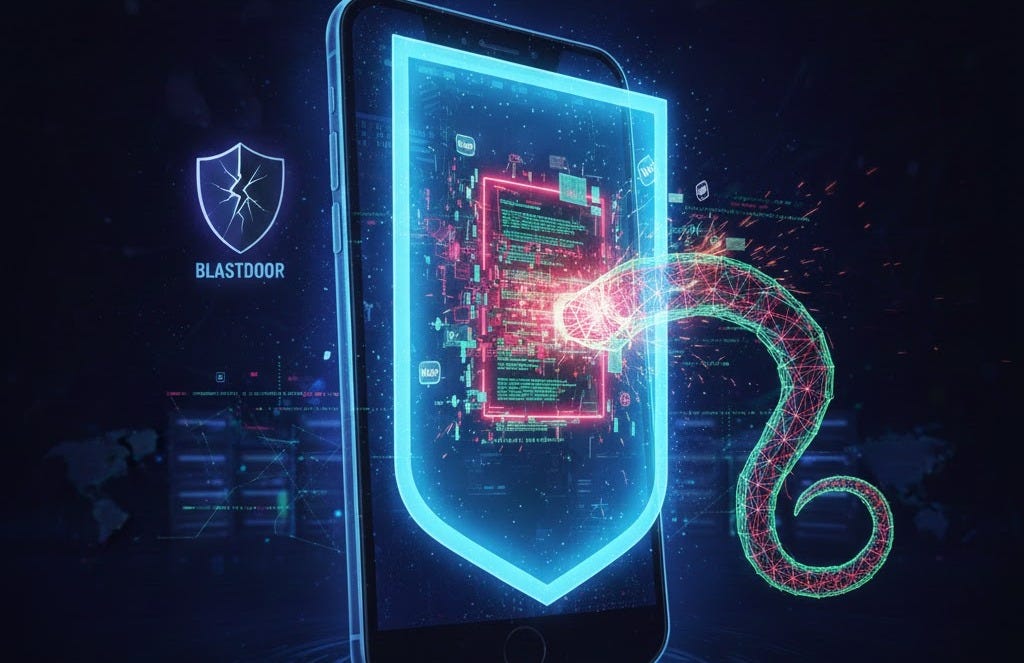
This isn’t a plot from a spy movie; it’s the reality of modern Zero-Click exploits. Based on recent research into a massive vulnerability in the WebP image format, here is how attackers turn a simple image preview into a master key for your device.
The Goal: Remote Entry
For a sophisticated attacker, the “holy grail” is Remote Code Execution (RCE). This means they want to run their own malicious code on your phone, no matter where you are in the world. To do this, they look for “attack surfaces”—the digital doors and windows through which your phone communicates with the outside world.
Common entry points include:
Phone calls and SMS.
Emails.
Messaging apps like iMessage, WhatsApp, and Signal.
Among these, iMessage is a prime target. It is installed on every iPhone by default and handles incredibly complex data to give you those nice link previews and animations.
The Weapon: Mathematical Complexity
We see an image as a picture. A computer sees an image as a massive, complex mathematical puzzle. To show you a photo, your phone has to “parse” (read and deconstruct) the file format—whether it’s a JPEG, a PNG, or the newer WebP.
This parsing process involves intense math and compression algorithms. Because this code is so complex, it is prone to tiny mistakes. Attackers look for these mistakes, known as bugs, specifically in the shared libraries your phone uses to read images.
The Defense: BlastDoor
Apple isn’t unaware of these risks. They created a security feature called BlastDoor.
Think of BlastDoor as a “quarantine room.” When you receive a message, the phone doesn’t open it in the main system. Instead, it sends the data to BlastDoor—a heavily restricted “sandbox.” If an image contains a malicious payload that causes a crash, the damage is contained within that room and cannot reach your private photos or passwords.
How the Hack Was Found
How do researchers find these bugs if they are too well-hidden for standard testing tools? The theory is that it comes down to “connecting the dots” between different technologies:
Shared Algorithms: Many image formats use a common compression method called Huffman coding.
The “enough.c” Flaw: Many developers use a tool called
enough.cto calculate how much memory they need to decode these images.The Oversight: It turns out
enough.cassumes the image it’s analyzing is “correct.” But an attacker can send a malformed image that breaks those assumptions, causing the memory to overflow.The Discovery: By noticing warnings about this tool in one library (like a JPEG tool), a researcher could realize that the WebP library—used by millions of iPhones—might have the exact same weakness.
Why This Matters
The WebP vulnerability was used in the wild to target individuals. The phone would receive a malicious image via iMessage, the system would fail to parse it correctly, and the attacker would gain a foothold, all without the user ever knowing something was wrong.
How to stay safe:
Update Regularly: These vulnerabilities are “Zero-Days” until they are patched. Your best defense is keeping your software up to date.
Enable Lockdown Mode: If you are in a high-risk profession (like journalism or activism), Apple’s “Lockdown Mode” disables many of these complex features to keep you safe.


