

You spent six months and millions of dollars training a machine learning model. Your company’s competitive edge sits in those weights and parameters. Then an attacker queries your API a few thousand times and walks away with a working copy.
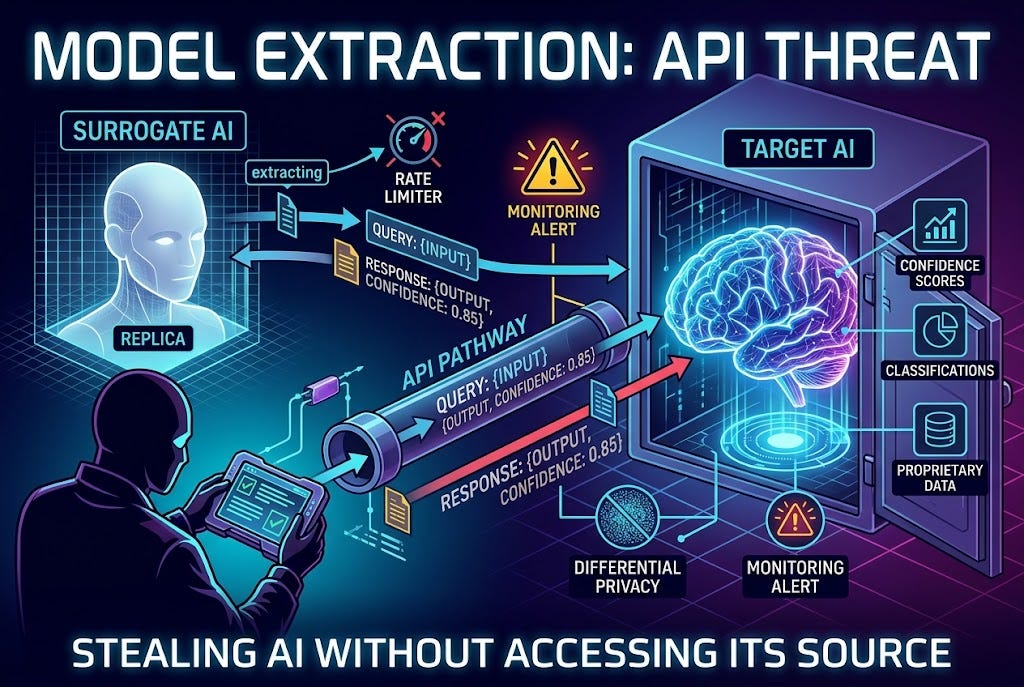
This is a model extraction attack, one of the most underestimated threats in AI security.
What Is a Model Extraction Attack?
A model extraction attack happens when an attacker replicates your AI model by observing its behavior through API calls. The attacker doesn’t need your source code or training data. They only need access to your model’s outputs.
Here’s the core idea: machine learning models are mathematical functions. Feed them the same input twice, you get the same output twice. If an attacker can query your model thousands of times and record the patterns, they can train their own surrogate model—a copy that approximates the original.
A surrogate model is a replica trained entirely from observed inputs and outputs. It doesn’t require stealing your weights or accessing your servers. It’s built by reverse-engineering your model’s behavior through normal API queries.
Why This Matters
Models represent serious investment. Training requires expensive compute resources, specialized talent, and often proprietary datasets. A stolen model gives attackers all that capability without the cost.
But theft isn’t the only damage. Once attackers have a copy of your model, they can:
Craft adversarial attacks. Knowing how your model makes decisions lets them craft inputs designed to fool it—queries that should return safe predictions but instead return dangerous ones.
Find additional vulnerabilities. A copy of your model becomes a test bed. Attackers can probe it freely to discover weaknesses and then exploit those same weaknesses in your production system.
Launch downstream attacks. Your model may be part of a larger system. Stealing it reveals how that system works and where else it’s vulnerable.
For open-source base models, extraction is even faster. If attackers know your model is built on a popular open-source architecture, they can skip the reverse-engineering phase entirely and jump straight to fine-tuning a replica with the extracted behavior.
