

Machine learning lives on a knife’s edge. Get it wrong in one direction, and your AI becomes a useless parrot. Get it wrong in the other, and it misses obvious patterns. The balance between these two failures is the central tension of overfitting in machine learning—and understanding it separates systems that work from systems that fail spectacularly.
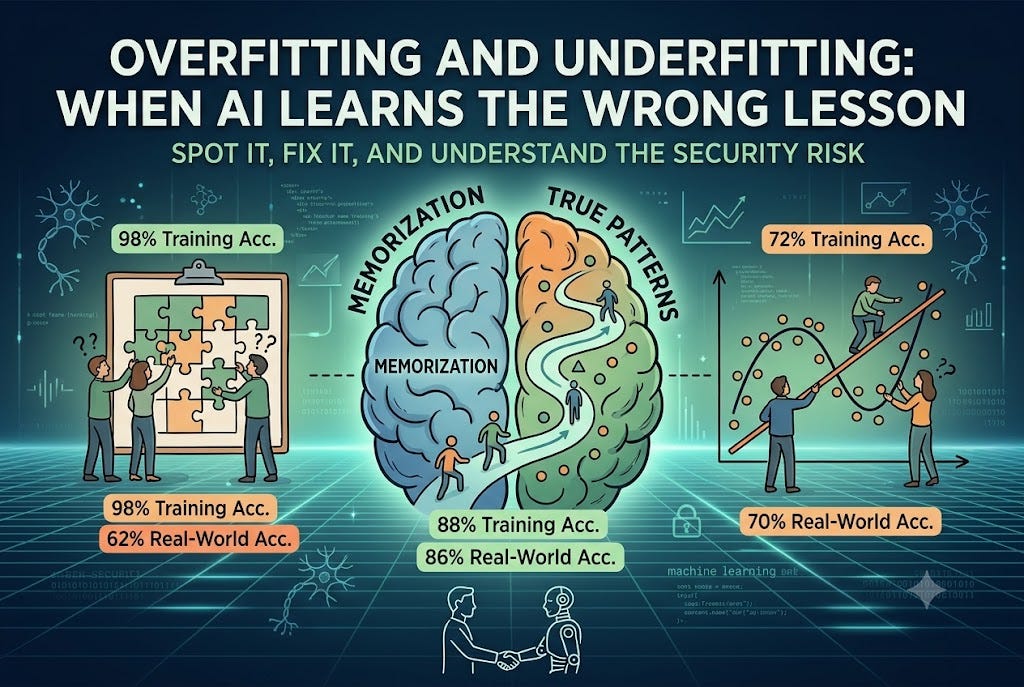
The core challenge is generalization: building a model that performs well not only on the training data it saw but also on new, unseen data in production. Most of what matters happens outside the training set.
Overfitting: When AI Memorizes Instead of Learns
Overfitting happens when an ML model learns the training data too thoroughly. It memorizes exact patterns, noise, random fluctuations—everything. On the training data, performance is flawless. On new data? It collapses.
Imagine a student studying for an exam by memorizing the answers to past test papers word-for-word. On the original exam, a perfect score. Given a slightly different question on the same topic, they’re lost.
Here’s what overfitting looks like in practice:
Scenario Training Accuracy Real-World Accuracy Well-fit model 88% 86% Overfit model 98% 62% Underfit model 72% 70%
The overfit model is memorizing noise in the training data—quirks and peculiarities that don’t reflect real patterns. It’s learned the specific training examples, not the underlying logic.
Underfitting: When AI is Too Simple
Underfitting is the opposite problem. The model is too simple to capture what’s actually happening in the data. A straight line can’t describe a curve. A coin flip can’t diagnose cancer.
An underfit model performs poorly on both training and new data. It’s not memorizing—it’s just not learning anything useful. The student who didn’t study at all performs equally poorly on both past and new exams.
