

Security teams have spent the better part of two decades refining how they catch vulnerabilities. Static analysis, fuzzing, threat modeling, SDLC gates: the tooling matured, the processes matured, and for a while it felt like the industry was closing the gap between how fast code got written and how fast it got checked.
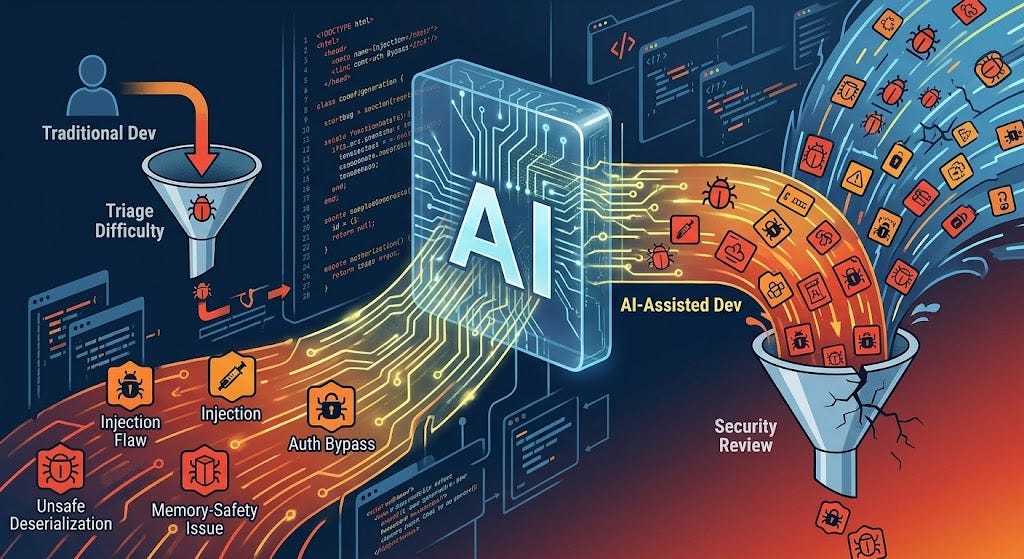
Then AI-assisted development arrived and reset the ratio.
Code generation tools don’t just make developers faster, they make vulnerability-producing patterns faster too. If a codebase historically introduced a certain class of bug once a sprint, an AI-assisted team can introduce the same class of bug a dozen times a sprint, because the model is statistically likely to reproduce whatever patterns dominate its training data, bugs included. The result isn’t a handful of genuinely novel threat categories. It’s the same familiar categories, injection flaws, auth bypasses, unsafe deserialization, memory-safety issues, showing up at a volume no human review queue was sized for.
This is the actual crisis hiding inside the “AI is creating thousands of new vulnerabilities” headlines: it’s not new kinds of problems, it’s the same old problems at an unfamiliar scale. And most security programs are architecturally unprepared for that, because they were built around a “fight the one-on-one battle” model: find a bug, patch a bug, repeat.
Why one-off remediation breaks down at AI scale
Traditional vulnerability management assumes a rough equilibrium: the rate at which flaws are introduced is slow enough that a triage-and-patch workflow can keep pace. Break that equilibrium and the workflow doesn’t degrade gracefully, it collapses. Teams either:
Drown in backlog, triaging thousands of near-duplicate findings that all trace back to the same underlying gap in a training pattern, a missing guardrail, or a misused library, or
Turn off the alarm, tuning scanners and gates to reduce noise until real signal gets lost with it.
Neither is a security posture. Both are surrender dressed up as pragmatism.
The way out isn’t more scanning. It’s a shift from instance-level remediation to class-level prevention: treating each vulnerability report not as a ticket to close, but as a diagnostic signal about where the development process itself has a gap.
