

If an AI system’s decisions affect the data it’s later retrained on, it can learn from its own mistakes in the worst way. A small bias in the first version can grow with each update, and the usual accuracy numbers may never show it.
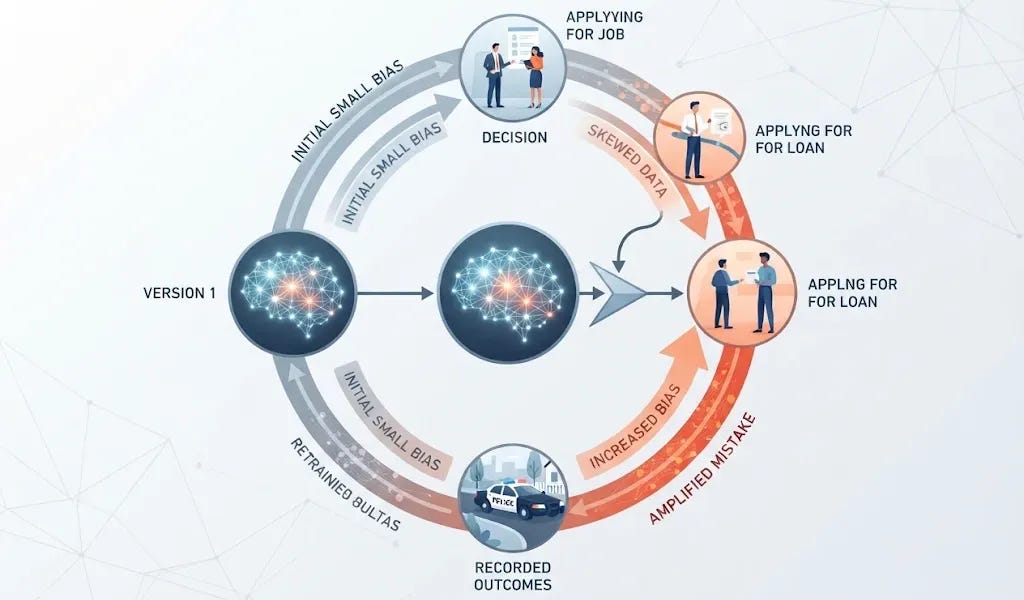
Most bias problems start in the training data. The worse ones start after the model goes live.
A model makes decisions: which resumes get read, who gets a loan, which neighborhoods get patrolled. Those decisions shape what happens next, and what happens next gets recorded. Later the model is retrained on those records, so it’s partly learning from its own earlier choices.
If the first version was a little biased, the next one inherits that bias plus whatever the first one caused. Each step looks normal, which is why nobody notices.
Where the bias starts
Models learn from historical examples. When those examples are skewed, the model picks up the skew.
A 2018 study of commercial face analysis tools found error rates as high as 34.7% for darker-skinned women and under 1% for lighter-skinned men. The public datasets used to test these tools were mostly lighter-skinned faces.
That same year, Reuters reported that a large tech company had dropped an experimental resume-screening tool. It was trained on ten years of resumes, most of them from men, and it learned to mark down resumes that included the word “women’s.”
In criminal justice, a 2016 ProPublica analysis of a widely used risk score found that Black defendants who didn’t reoffend were labeled high risk about twice as often as white defendants. The vendor disputed the findings, and researchers still argue about how fairness should be measured in cases like this.
How the loop closes
The clearest example comes from predictive policing. These tools send officers to wherever past records show the most crime. But crime only gets recorded where police are looking. If the model sends patrols to neighborhood A, police find crime in A, and that goes into the data. Next time, the model sends even more patrols to A. Neighborhood B produces fewer records, so the model never learns that B may have just as much crime.
Researchers have shown this effect with both real police data and math. Even when two areas have the same true crime rate, the system can keep pointing at the same one.
The same pattern shows up elsewhere. A hiring model only sees how the people it recommended did on the job. A lending model only learns whether approved applicants repaid. AI-generated content now ends up online and gets collected to train the next models. In each case, the model’s own output becomes part of what it learns from next.
Why it’s hard to see
Every step sounds reasonable on its own. The data reflects what actually happened. The model only recommends, and people make the final call. Retraining on fresh data keeps the model current. Accuracy even goes up.
That last part is the trap. The model looks accurate because it’s partly predicting the results of its own decisions. By the time an audit, a lawsuit or a news story brings the problem to light, the bias has been carried through several versions and a lot of real decisions.
Why security teams should care
Feedback loops give attackers an opening. If someone can influence what gets recorded, through fake reports or coordinated activity, they can steer the next version of the model without ever breaking into anything.
Models that learn too much from their own output also get worse at handling anything new. Research on generative AI has shown that training on model-generated data without filtering slowly erases the rarer cases in the data.
Regulators have noticed. The EU AI Act specifically requires high-risk systems that keep learning after deployment, such as hiring tools and reoffending risk assessments, to reduce the risk of biased feedback loops. Under the current timeline, those rules apply from December 2027.
What teams can do
Start by asking where your training data comes from. If the model’s earlier decisions shaped it, you may have a loop.
Keep some decisions independent of the model, so you still have outcomes it didn’t influence.
Check results for different groups every time the model is updated, and compare each version with the last one. A gap that keeps growing is a warning sign.
Keep track of which data the model influenced or generated, so you can filter it out when you need to.
Have people review high-stakes decisions, but remember that reviewers who see the model’s score aren’t fully independent.
When you find a loop, retrain on data the model didn’t touch.
What you can control
You won’t remove every bias from real-world data. You can stop it from growing with every update, and that starts with knowing which parts of your data the model helped create.
If you’ve seen a feedback loop in a real system, reply and tell me about it. I’d like to collect real examples for a follow-up.