

Most events in the real world aren’t actually typical. Walk into a grocery store on Tuesday afternoon, and you’ll see the expected rush. A power outage on a holiday weekend? Still happens. The AI long tail problem describes exactly this mismatch: AI systems excel at predicting common scenarios but catastrophically fail on rare ones.
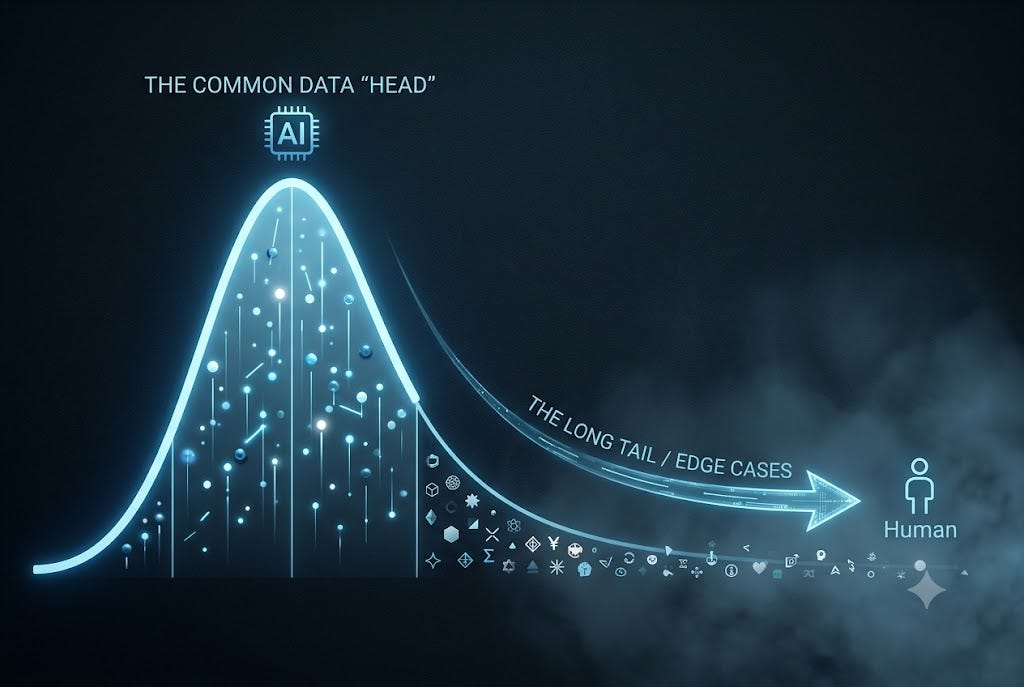
Think of a bell curve with a long, thin tail stretching to the right. The thick middle is where most data clusters—the “head.” That tail contains the rare, unusual events. ML models train on what’s probable. They learn the head exceptionally well. The tail? They’ve never seen it, and they don’t know what to do when it shows up.
How the Long Tail Breaks AI Systems
An autonomous vehicle’s neural network (a type of machine learning model that mimics how the brain processes information) trains on thousands of hours of normal driving: clear roads, daylight, predictable pedestrians. It learns those patterns cold. Then winter arrives.
Heavy snow obscures lane markings. Glare from the low sun reflects off wet pavement. A driver parks in an unusual spot. These aren’t impossible events—they happen regularly in many places. But if the training data included only light rain and spring sunshine, the vehicle’s AI hasn’t learned how to respond. It makes a confident guess. It’s often wrong.
Medical diagnosis AI shows the same weakness. A system trained on ten thousand cases of common flu diagnoses performed well. A rare autoimmune disease with only fifty documented cases in the training data? The model has virtually no basis to recognize it. It either misses it entirely or flags too many false alarms.
Fraud detection systems live on this boundary constantly. Most transactions are normal—legitimate purchases, standard patterns. Fraud is rare. But attackers deliberately craft transactions that look normal to the model. They’re testing the boundaries. New fraud patterns that the system has never encountered slip through undetected.
