


If you’ve seen “Jev” trending across dev Twitter, Hacker News, and Reddit over the past week and aren’t sure whether it’s a new model, a company, or a meme, this guide covers everything currently known: what it is, how it works, how to access it, how people are integrating it with tools like Claude Code, and where the claims around it deserve a skeptical eye.
What Is Jev?
Jev is an AI model released by TypeSafe AI, a San Francisco startup founded in 2024, launched in limited early access on September 15, 2026. The launch came alongside a $40 million seed round led by DCVC, reportedly valuing the company around $200 million.
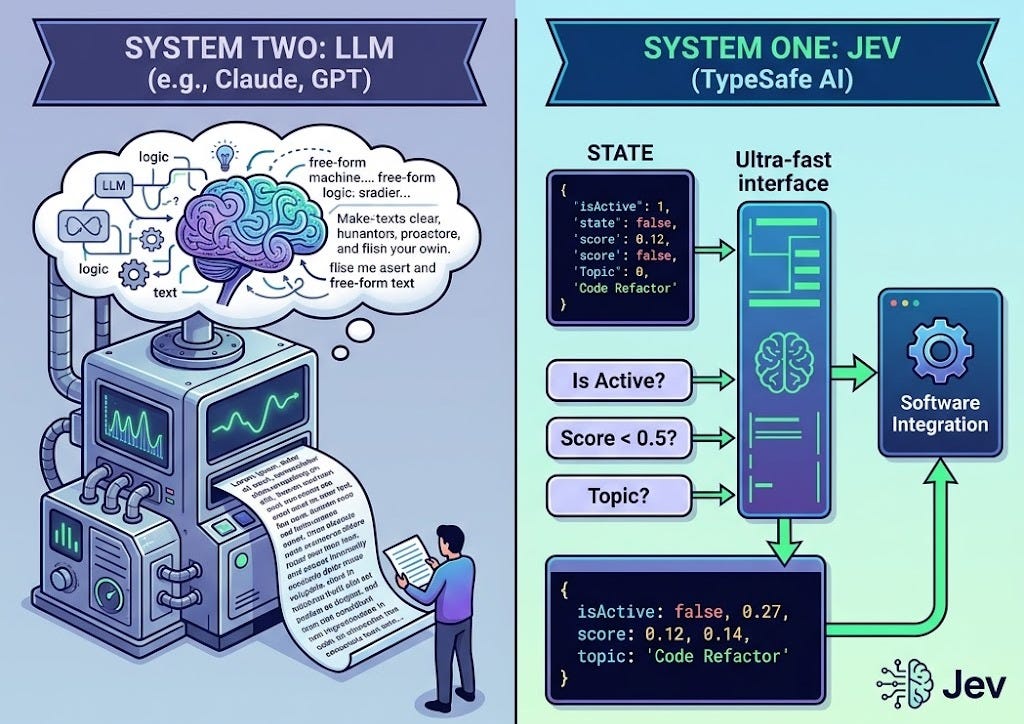
TypeSafe describes Jev as the first of a new model category it calls “System One Models.” The core distinction from a large language model (LLM):
An LLM (Claude, GPT, etc.) generates free-form natural-language text, token by token, meant to be read by a person or parsed after the fact.
Jev does not generate text at all. It takes a block of state (a string, JSON object, or array of text) plus one or more typed questions, and returns structured, typed answers with probability estimates and confidence scores meant to be consumed directly by software, not read by a human.
If your use case ends in “write me a sentence,” Jev is not for you. If it ends in “should this be true or false,” “which of these five categories does this fall into,” or “how confident are you in this,” that’s the shape of task Jev targets.
The name
Jev is named after William Stanley Jevons, the 19th-century economist behind the Jevons paradox the idea that making a resource more efficient to use can increase total consumption of it, not decrease it. TypeSafe’s founder has framed this as the thesis behind Jev: making machine “decisions” dramatically cheaper won’t reduce AI spend, it’ll expand what people build with AI.
Who built it
TypeSafe AI was founded by Diogo Almeida, Erik Gafni, and Sasha Sheng. Almeida spent roughly four years at OpenAI working on RLHF, InstructGPT, ChatGPT, and GPT-4 before leaving in 2024. Jev was reportedly developed in stealth for about two years before this launch.
How Jev Works
The System 1 vs. System 2 framing
TypeSafe borrows its terminology from Daniel Kahneman’s Thinking, Fast and Slow:
System 2 = slow, deliberate reasoning. This is where TypeSafe places today’s chain-of-thought LLMs: they “think,” produce tokens, and take real compute and latency to do it.
System 1 = fast, intuitive, pattern-matched judgment. This is where Jev is positioned: a model built purely to make quick, calibrated decisions, not to reason step by step in language.
The request/response shape
A Jev call consists of:
State the context the decision is about (a document, a conversation, a tool call log, structured data).
One or more typed questions each with a predefined output schema (e.g., a boolean, an enum of categories, a 0–1 confidence score).
Jev evaluates every question against the state in a single parallel pass, and returns typed answers constrained to the schema you defined. Because the output space is fixed in advance, TypeSafe argues this structurally eliminates hallucination and type errors for this class of task; the model literally cannot return a value outside what you told it was possible.
Training approach
TypeSafe hasn’t published Jev’s architecture, parameter count, or a technical paper. What they have disclosed:
It’s transformer-based.
It’s trained exclusively on synthetic data.
Training uses a method TypeSafe calls “Reinforcement Learning for Calibrated Decisions” (RLCD), optimizing the model’s output probabilities against real outcomes, rather than against human rater preference (the way RLHF does for chat models).
Some independent commentators speculate Jev may be built on top of an existing open-weight LLM rather than trained from scratch, but this hasn’t been confirmed.
How to Access Jev
There is currently no way to run real Jev locally or self-host it. Weights, architecture, and parameter count are all unpublished, and TypeSafe has stated that all customers use the same weights (no per-customer fine-tuning).
Ways to call it
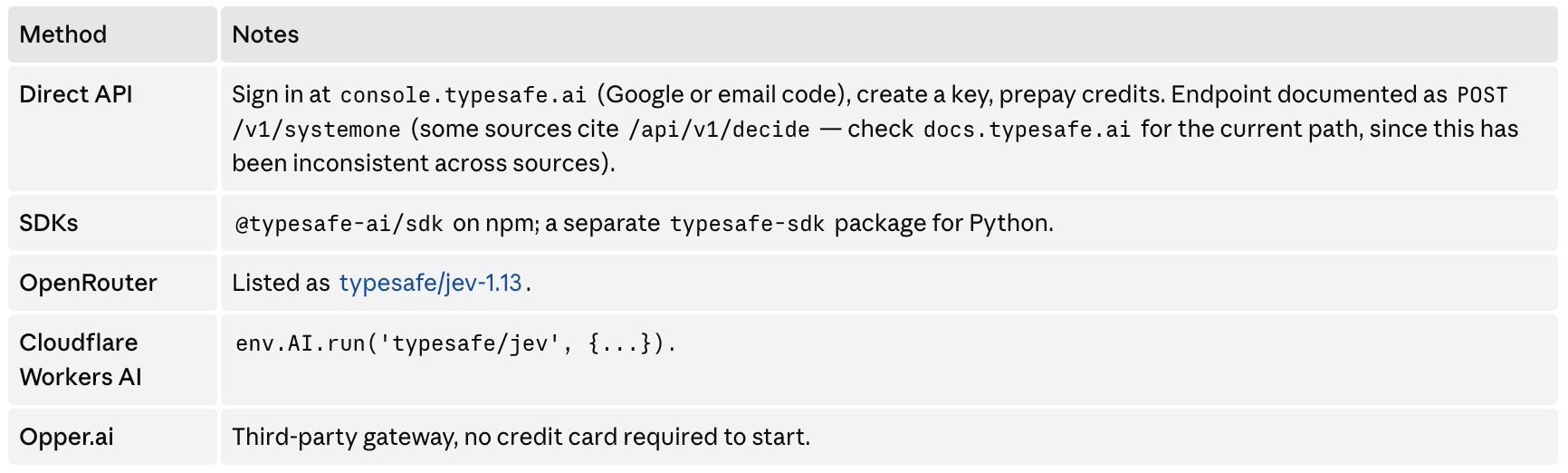
Access rollout has been reported inconsistently some sources say TypeSafe removed an early-access waitlist on September 20, 2026 (”available to everyone, no waitlist”), others describe an ongoing batch-invite queue. Verify current status directly on TypeSafe’s own site rather than trusting any single secondary source, given how new and fast-moving this is.
“Local” alternatives (not real Jev)
Community projects like OpenJev and its successor SemIf replicate Jev’s request/response contract (state + typed questions → typed answer) using an ordinary small LLM as the scoring engine, runnable fully offline via Ollama/llama.cpp. Their own documentation is explicit that these are not Jev they mimic the interface, not the model or its training.
Pricing
The most consistently corroborated figures (OpenRouter, and most independent trackers):

Output is free because Jev never generates text there’s nothing to meter on the output side.
Note the discrepancy:
TypeSafe’s own pricing page has at times displayed $0.42/million, a 10x difference from the OpenRouter-listed rate. The lower $0.042/M figure is far more widely corroborated, but given the product is only ~2 weeks old at the time of writing, double-check the live rate before budgeting anything at scale.
Cost-control tips (from TypeSafe’s own guidance)
Trim state to only the context the decision actually needs; you’re billed per input token.
Batch multiple questions against one state payload in a single call rather than issuing repeated calls.
Route by confidence: let Jev auto-resolve high-confidence cases, and only escalate low-confidence ones to a full LLM or human review.
Benefits of Using Jev
Speed. End-to-end response times of roughly 70–500ms, versus multi-second latency typical of frontier LLM calls for the same kind of decision.
Cost. At $0.042/M input tokens and free output, per-decision cost can run in the fraction-of-a-cent range. TypeSafe’s own benchmark claims a decision that costs ~$0.0004 versus dollars for an equivalent LLM-based pipeline.
Structural elimination of malformed output. Because answers are constrained to a schema you define upfront, there’s no free-form text to parse, and (by construction) no way to return a value outside the allowed type.
Parallel evaluation. Multiple questions against the same state resolve in a single pass, rather than needing separate sequential LLM calls.
Good fit as a pre-filter. Rather than replacing your LLM, Jev is best used ahead of it, cheaply triaging, classifying, and routing so your expensive model calls are reserved only for requests that actually need generation or deep reasoning.
How People Are Using Jev With Claude / Claude Code
Jev is not a replacement for Claude it can’t write code, prose, or explanations. The pattern people are actually using is Jev as a cheap decision layer inside a harness that still calls Claude for anything requiring real generation or reasoning. Two concrete shapes have emerged:
A. Pre-filtering / routing before a Claude call
Jev does a fast, cheap classification pass first “does this request even need a full model call,” “which sub-task is this,” “how confident are we already” and only escalates to Claude when real reasoning or generation is actually required. This keeps token spend concentrated on the turns that need a frontier model, instead of paying frontier prices for every step of an agent loop.
B. Context compaction inside Claude Code
A community plugin, fast-jev-compaction, replaces Claude Code’s built-in /compact (which asks the model to write a lossy summary of old conversation history) with a Jev-scored approach: every tool call and result outside a protected recent window gets scored, and anything below a keep-threshold is dropped or truncated but whatever is kept is preserved verbatim, never rewritten or paraphrased. That’s a meaningfully different failure mode than a summary silently dropping a file path or error string.
Setup (as documented by the plugin):
// ~/.claude/settings.json
{
  "env": {
    "CLAUDE_CODE_ENABLE_FUNCTION_HOOKS": "1",
    "TYPESAFE_API_KEY": "<your key>"
  }
}
claude plugin marketplace add tamaratran/fast-jev-compaction
claude plugin install fast-jev-compaction@fast-jev-compactionRequires Claude Code ≥ 2.1.274, restart or /reload-plugins afterward.
Config defaults: keepThreshold 0.5, preserveRecentMessages 6, maxStateTokens 25,000, maxRequestTokens 30,000, truncateHeadChars 300.
⚠️ Important caveats before using this specific plugin:
It depends on
CLAUDE_CODE_ENABLE_FUNCTION_HOOKS, which traces back to a real but unshipped Anthropic proposal (GitHub issueanthropics/claude-code#91870, opened Sept 3, 2026). Anthropic’s own tracking describes it as a prototype behind a default-off flag, with core design details (”event names, hook failure behavior”) still unresolved as of early testing.There’s an open bug report (
tamaratran/fast-jev-compaction#76) that the plugin’s hooks fail to load on Claude Code 2.1.278 despite being above the stated minimum version; check this before relying on it.It’s a third-party plugin, not built or endorsed by Anthropic or TypeSafe. Installing it means enabling an early-access/experimental flag, trusting an unverified marketplace source, and handing it a live API key. Review the plugin’s actual source before installing, and treat it as experimental.
Limitations and Things to Know
32k context window: long documents need chunking or a retrieval step in front of Jev; it’s not built for large-context tasks.
Cannot generate free text. No summaries, no code, no explanations only typed decisions against a schema you define.
Closed weights. No transparency into architecture, size, or training data beyond TypeSafe’s high-level claims.
Not fine-tuned per customer; everyone calls the same base model.
A Necessary Skepticism Section
Before treating any of the above as settled fact, it’s worth being direct about something: most of the coverage of Jev online right now comes from a cluster of very new, low-authority sites that repeat identical, oddly specific statistics (e.g., “193.6x faster,” “444.6x cheaper,” “4,200 GitHub stars,” “1,863 points and 490 comments” on a Hacker News thread). This pattern many freshly-registered domains, all echoing the same numbers within days of each other is a known signature of coordinated SEO/content-farm activity, not necessarily organic independent reporting. That doesn’t mean nothing here is real (TypeSafe AI, Jev, and the seed round appear to be genuinely reported by mainstream tech outlets like TechCrunch and The Register), but it does mean:
Every performance and cost claim above is self-reported by TypeSafe, using TypeSafe’s own benchmark methodology and reference answers. None of it has been independently reproduced in a published, third-party benchmark as of this writing.
The “0% type errors” claim is true by construction (schema-constrained output can’t be malformed), not an empirically measured result.
Community tooling (like
fast-jev-compaction) is unofficial, early, and in at least one case has an open, unresolved compatibility bug.
Practical takeaway: treat this guide as a snapshot of a fast-moving, two-week-old launch, verify pricing/access details directly at docs.typesafe.ai before committing spend, and read the source of any third-party plugin before installing it, especially one that asks you to enable experimental flags and hand over a live API key.
Quick FAQ
Is Jev open source? No. Closed weights, no published paper, no architecture disclosure.
Can I run it locally? No official way. Community projects (OpenJev, SemIf) approximate the interface using a local LLM, but explicitly are not the real model.
Does Jev replace Claude/GPT? No, it can’t generate text. It’s a cheap decision/classification layer meant to sit alongside or ahead of a full LLM, not replace it.
What’s it actually good for? Classification, routing, scoring, verification, and other fixed-schema decisions inside a larger pipeline anywhere you’re currently paying LLM prices just to get a yes/no, a category label, or a confidence score.
Is it actually 40–400x cheaper, as claimed? That’s TypeSafe’s own self-reported benchmark. Independent, publicly available, reproducible verification doesn’t yet exist. It is true that Jev is priced far below typical frontier LLM input rates and that outputs are free, so directionally the cost advantage for narrow decision tasks is plausible; treat the specific multiplier with skepticism.