Managing security across a large company is often messy. Every team uses different tools and has their own way of writing rules. In a large environment, it's possible that no one knows which system follows which policy. Open Policy Agent (OPA) fixes this by bringing order to the chaos.
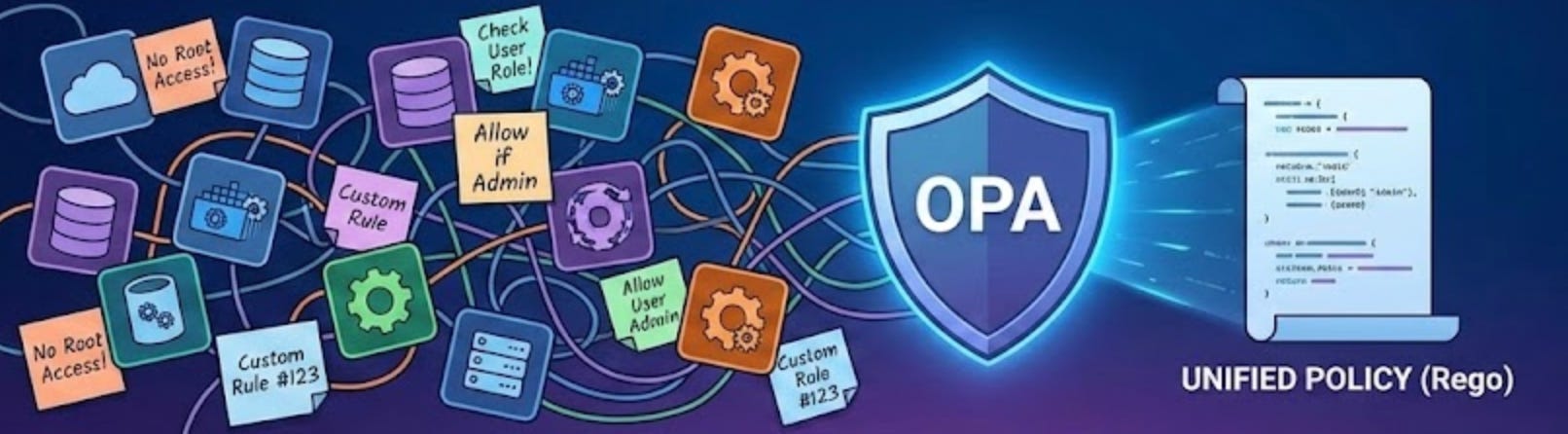
OPA gives you one consistent way to write and enforce rules across your whole company. Instead of hard-coding rules into every application, you centralize them. This makes your systems easier to secure and much faster to audit.
What Is OPA?
Open Policy Agent is an open-source policy engine. You write rules using a language called Rego, and OPA decides if an action is allowed or denied.
Why OPA?:
It works everywhere: Use it for Kubernetes, APIs, or cloud infrastructure.
It is fast: Decisions happen in milliseconds without slowing down your app.
It uses standard data: OPA reads JSON and YAML, which most modern tools already use.
Policy as Code: You can manage your rules just like software code—with version control and reviews.
How OPA Works
OPA follows a clear, simple process to make decisions:
You define a rule: For example, “Every database must be encrypted.”
Your system sends data: Your app sends information (like a user’s role or a server setting) to OPA.
OPA checks the rule: It compares the data against your Rego policy.
OPA returns a decision: It says “Allow” or “Deny.”
Your system enforces it: Your app follows OPA’s decision.
Note: OPA is to make decisions, but it doesn’t take action itself. Your application is the “muscle” that actually blocks or allows the request.
Common Ways to Use OPA
Here are four ways big companies use OPA every day:
1. Kubernetes Admission Control
Large teams run hundreds of clusters. OPA (often used with Gatekeeper) ensures everyone follows the same safety standards.
Block containers that try to run as “root” (admin).
Make sure every project has an owner tag for billing.
Only allow apps from your company’s private registry.
2. API and Microservices Security
Instead of writing “if/else” logic for security in every microservice, OPA handles it centrally.
Check if a user has the right role to delete data.
Verify JWT tokens and user claims automatically.
3. Infrastructure as Code (IaC)
OPA can check Terraform or CloudFormation plans before you deploy them to the cloud.
Stop anyone from accidentally creating a public S3 bucket.
Ensure all new servers have logging enabled.
4. CI/CD Pipeline Safety
Use OPA to make sure only safe changes move forward in your deployment pipeline.
Prevent code releases during “freeze” periods.
Ensure a security scan passed before the code goes live.
Deployment: Sidecar vs. Centralized
In a cloud-native setup, most teams run OPA as a sidecar. This means a small OPA container runs alongside your application. This setup provides zero-latency because the app doesn’t have to talk to a distant server to get a security decision.
Challenges to Keep in Mind
OPA is powerful, but it isn’t “magic.” Here is what to expect:
Learning Rego: The language is unique and takes developers a few days to learn.
Coordination: Security and platform teams must work together to agree on the rules.
Conclusion
Open Policy Agent brings clarity and control to complex enterprise environments. It gives organizations a single way to write and apply rules across Kubernetes, APIs, cloud resources, and CI/CD pipelines. With OPA, teams get safer systems, better governance, and cleaner workflows.


