

Latio’s 2026 AI Security Market Report tracks roughly 400 AI security startups competing for the same buyers and budgets. That number alone tells you this is a market in its land-grab phase. But the more useful signal in the report isn’t the vendor count; it’s the direction the entire category has pivoted in over the last twelve months, and what that pivot means for anyone actually responsible for securing AI in production.
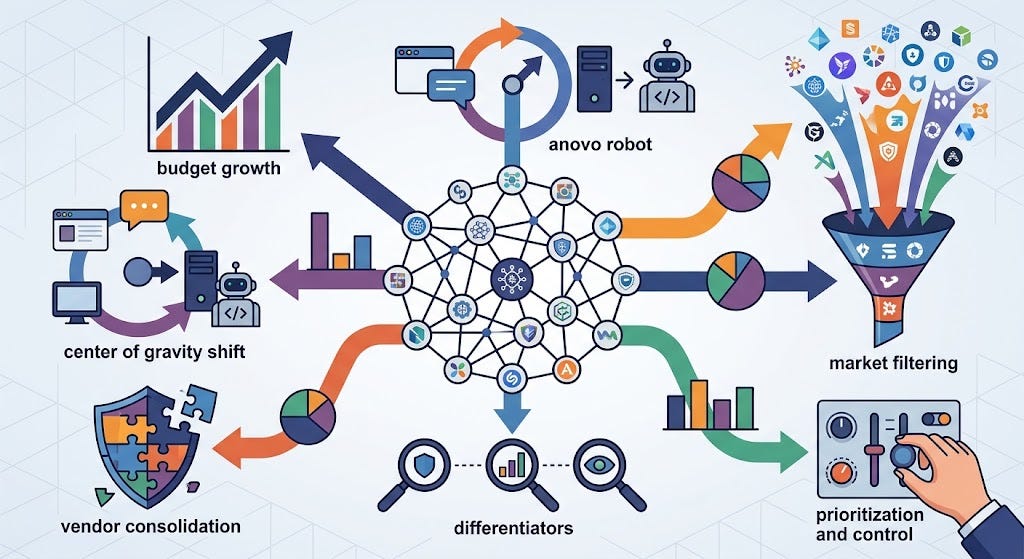
Security moved from the browser to the endpoint
A year ago, “AI security” mostly meant governing ChatGPT and Microsoft Copilot usage: preventing shadow AI, stopping sensitive data from leaking into an unapproved LLM, catching prompt injection against a chat interface. Those are browser and proxy problems, and the market matured quickly around them. SentinelOne and CrowdStrike acquired their way into the space; Palo Alto Networks, Check Point, Cato, and Tenable all bought browser- and proxy-focused AI security vendors through 2025.
In 2026 that center of gravity moved. The report’s survey data is blunt about it: primary AI security concern split 45% endpoint agents (think Claude Code, Codex), 23% first-party agents, 22% browser applications, and only 10% hosted agents. A year earlier, endpoint agents weren’t even a category vendors were building for. Now, per the report, “a platform is incomplete without one.”
This matters because endpoint agents are a categorically different threat surface than a chat window. They have local permissions. They can generate and execute code. They interact directly with developer tooling. They operate with access that extends well past a browser session’s blast radius. Governing “what an employee typed into a chatbot” and governing “what an autonomous coding agent can read, write, and execute on a laptop with real credentials” are not the same problem, and most existing security stacks were not built for the second one.
Budget is no longer the bottleneck; prioritization clarity is
One of the more concrete data points: teams with dedicated AI security budget went from 8% to 37% in a single year, with another 24% undecided. That’s a real signal of market maturity, not hype. AI security is graduating from “something we’re monitoring informally” to a line item with named ownership, spread across Product Security, Security Operations, and IT.
The practical implication for security engineers: if your organization hasn’t allocated budget yet, you’re now behind roughly a third of your peers, and “undecided” (24%) is quickly becoming the minority position too. The harder problem isn’t getting budget approved, it’s knowing what to spend it on, because the vendor landscape is genuinely confusing right now.
Why the vendor landscape is so hard to parse
The report is candid that most of the “noise” in AI security comes from existing security categories rebranding into the space rather than genuinely new capabilities. CNAPP vendors now cover Bedrock and SageMaker misconfigurations and call it AI security. ASPM vendors extended into AI-generated code scanning and “AI red-teaming.” Identity and non-human-identity vendors reframed agent-permission sprawl as an AI problem, when in practice, per the report, most “agentic identity” issues are really agents using existing overpermissioned access or tokens.
This is a useful filter to apply as a buyer: before treating a new “AI security” purchase as necessary, ask whether your existing CNAPP, ASPM, CADR, or IGA tooling already covers the specific capability, just under a new AI-flavored label. The report’s own capability table makes this explicit, mapping cloud security, application security, and identity security capabilities directly onto their pre-AI tool categories. In a lot of cases, the right answer is extending what you already have rather than adding a net-new vendor.
Where dedicated tools genuinely differentiate is narrower than the marketing suggests: secure configuration coverage for newer managed services like Agentcore and Foundry, advanced AI red-teaming and data-poisoning test cases, and specialist permission models specifically for MCP servers. Everywhere else, the “AI security” label is largely a repackaging exercise.
Three integration points, three different blind spots
The report breaks down where AI security vendors actually plug into your environment: network proxies, endpoint agents, and hooks/gateways (like inference hooks). Each comes with a real trade-off, not just a deployment preference:
Network proxies give you flexible runtime engines that work across most agent types, but they’re blind to local permissions, an agent’s reasoning process, or what it’s actually touching on disk.
Endpoint agents give you deep visibility into permissions and local behavior, but they don’t extend well to SaaS-hosted or first-party agents running elsewhere.
Hooks and gateways (a newer integration point, exemplified by Anthropic’s recently released inference hooks and compliance API) give you session-level visibility and the ability to alter an agent’s context window in-flight, but not every agentic platform supports them, and they can’t touch device-level settings.
The report’s conclusion here is worth internalizing: there is no single correct integration point. Comprehensive coverage requires combining all three, and the right combination depends on where your actual risk concentration is, not on which integration point is easiest to deploy first.
The real differentiator: permissioning and prevention, not detection
A subtler point buried in the “Innovative Capabilities” section is arguably the most important one for security engineers building a program: the meaningful competitive differentiation among vendors isn’t detection sophistication, it’s how tightly a platform can control what tools and permissions an agent has before it acts.
This shows up in a few concrete capability areas the report highlights:
Skill detonation: executing a Skill (effectively a mini-application, sometimes just markdown, sometimes bundled with scripts and packages) in a sandboxed environment at runtime to observe network egress and process execution before trusting it, because static analysis stops working once a Skill can fetch external content or manipulate its own expected behavior.
MCP and Skills marketplaces: governed, self-service flows for discovering and vetting agent capabilities across teams, rather than every team independently deciding what an agent is allowed to install and call.
Granular, identity-aware permissioning: mapping an agent’s local file-system access to its cloud IAM role, so blast radius is understood end-to-end rather than piecemeal.
Intent-based detection: analyzing an agent’s system prompt against expected goals and organizational guardrails, then monitoring the live session for conformity. The report includes a pointed caveat here worth repeating directly to any vendor evaluation team: “many runtime detection engines are not as powerful as promised.” Test this capability hands-on before buying it.
The throughline is prevention over detection: supply chain risk from MCP servers and Skills (many distributed as NPM packages, carrying the same risk profile as any open-source supply chain malware) is treated as more urgent than any exotic new AI-specific threat class.
What this means for how you buy
The report’s buyer’s guide is organized around a distinction every security engineer building an AI security roadmap should adopt explicitly: first-party agents (your own homegrown agents, e.g. built on LangChain or Crew) versus third-party agents (Claude Code, Codex, and similar tools running on workforce endpoints).
For first-party agents, the report’s advice is proportionality: a simple chat-based internal tool with no access to real customer data poses limited risk and is probably already covered by your existing application and cloud security stack. Complexity is what changes the calculus, once a first-party agent has real data access or takes consequential action, you need actual AI red-teaming and runtime defense, not just posture checks.
For third-party agents, the report frames it as a first real decision point: partner with an endpoint specialist if AI security is a dedicated priority requiring deep control over employee endpoints, or lean on a broader AI security platform if you want AI governed as part of a wider security program that multiple teams already touch. Most teams end up doing both, one endpoint tool for general workforce AI usage, and a specialist tool for developer-specific coverage, because traditional EDR and MDM tooling still doesn’t understand IDE-plugin or developer-supply-chain threats.
Where this is heading
The report’s own prediction is a useful planning input: the “hosted endpoint” (agents run through managed platforms like Agentcore and Foundry) is positioned as the 2027 equivalent of what the “agentic endpoint” is in 2026. In other words, the current scramble to secure agents running directly on laptops is itself a transitional phase. As more organizations centralize agent deployment into managed cloud platforms rather than letting them run wherever an employee installs them, the security perimeter will shift again, this time toward the platforms hosting the agents rather than the devices running them.
The practical takeaway for anyone building a security program right now: don’t over-invest in point solutions tied narrowly to today’s endpoint-agent problem. Prioritize vendors and architectures that are moving with the frontier model providers (who are shipping new control surfaces, like inference hooks, faster than most vendors can differentiate around them) rather than vendors betting the business on the current endpoint moment being permanent.
The bottom line
AI security in 2026 isn’t a single new discipline, it’s several existing disciplines (CNAPP, ASPM, IGA, DLP, EDR) racing to extend into a new, higher-stakes execution surface: autonomous agents with real permissions and real access. The most useful thing a security engineer can do with this report isn’t memorize the vendor map, it’s use the report’s own framework, first-party versus third-party, posture versus runtime, proxy versus endpoint versus hook, to figure out which gaps in your current stack are actually gaps, versus which ones are just missing an AI-flavored label on a capability you already own.
Reference: 2026 AI Security Market Report, Latio